Auxiliary Verb (Group 1) (Basic ㊦ 403)
An auxiliary verb which indicates the completion of an action.
Equivalent: Have dome something; finish doing something; finish something up
| Vて | しまう | |
| 話してしまう | Have talked | |
| 食べてしまう | Have eaten |
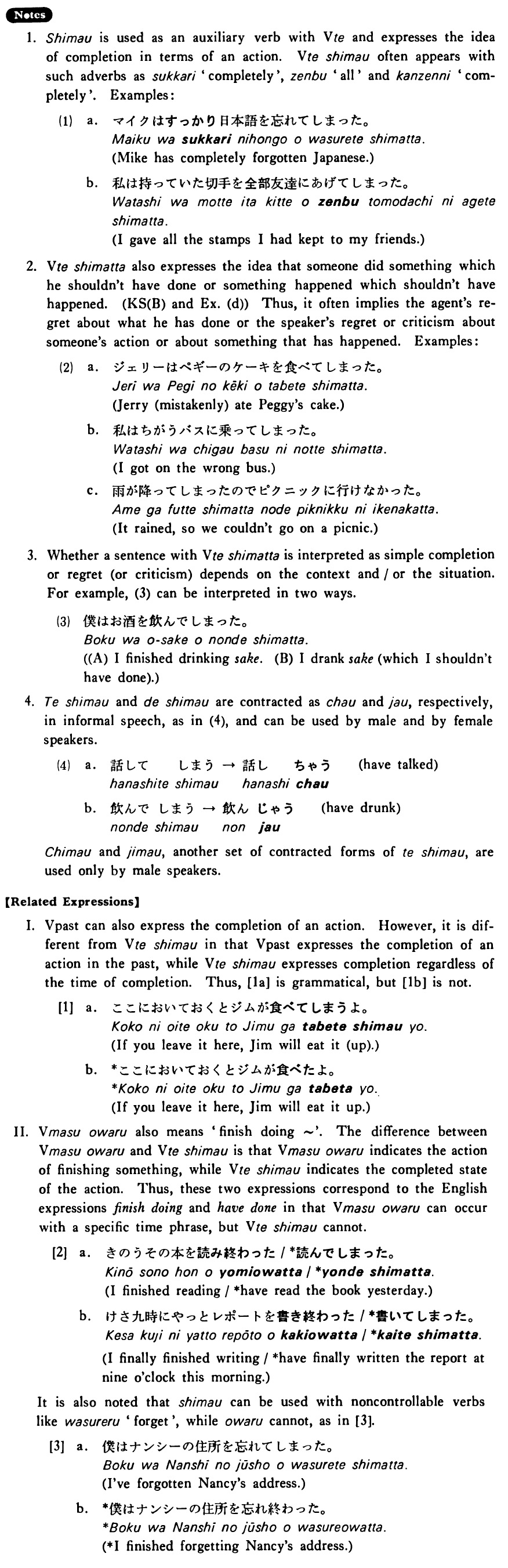
1. しまう is used as an auxiliary verb with Verbて and expresses the idea of completion in terms of an action. Verbてしまう often appears with such adverbs as すっかり 'completely', 全部 'all' and 完全に 'completely. Examples:
2. Verbてしまった also expresses the idea that someone did something which he shouldn't have done or something happened which shouldn't have happened. (Key Sentence (B) and Example (d)) Thus, it often implies the agents regret about what he has done or the speaker's regret or criticism about someone's action or about something that has happened. Examples:
3. Whether a sentence with Verbてしまった is interpreted as simple completion or regret (or criticism) depends on the context and/or the situation. For example, (3) can be interpreted in two ways.
4. てしまう and でしまう are contractea as ちゃう and じゃう respectively, in informal speech, as in (4), and can be used by male and by female speakers.
ちまう and じまう, another set of contracted forms of てしまう, are used only by male speakers.
【Related Expressions】
I. Verb past can also express the completion of an action. However, it is different from Verbてしまう in that Verb past expresses the completion of an action in the past, while Verbてしまう expresses completion regardless of the time of completion. Thus, [1a] is grammatical, but [1b] is not.
[1]
II. Verbます終わる also means 'finish doing ~'. The difference between Verbます終わる and Verbてしまう is that Verbます終わる indicates the action of finishing something, while Verbてしまう indicates the completed state of the action. Thus, these two expressions correspond to the English expressions 'finish doing' and 'have done' in that Verbます終わる can occur with a specific time phrase, but Verbてしまう cannot.
[2]
It is also noted that しまう can be used with noncontrollable verbs like 忘れる 'forget', while 終わる cannot, as in [3].
[3]